Friday, November 28, 2008

Guided Adventures Grand Canyon Vacation Packages

One of the nation's top vacation locations has long been the scenic and majestic Grand Canyon. While some people study travel books offering foreign adventures there is one of the greatest thrills in the world awaiting them in the western portion of the United States. The awe-inspiring beauty of this natural wonder has attracted families and individuals for years and there are some Grand Canyon Vacation Packages that are certain to be the right fit for you and your group.

Today you can visit the Grand Canyon Walkway, which is also known as the Skywalk, and enjoy one of the best and most scenic ways to familiarize yourself with the canyon. The Skywalk extends 70 feet from the rim of the canyon. The panoramic views that you are afforded makes this a must do when you arrive. From your safe vantage point on the Walkway, you can look straight down into the valley of the canyon, which is almost a mile below where you are standing.

This Walkway is similar in shape to the letter "C" and the bridge you cross spans the mighty Colorado River. This bridge is constructed from glass and the views are simply breathtaking, but may be too intense for those with a fear of heights. This is a guided tour and cameras will not be permitted but you will have a chance to purchase photos from the tour guides. There are also some great package tours that can include any combination of fun activities that allow vacationing families to personalize their canyon trip.

You can choose to travel by air and these tours will take you around, over, and into the canyon itself. Tourists that choose planes or helicopters for their vacation exploration of the canyon will be thrilled to soar into the clouds and then swoop down for close up exploration with their experienced pilot and guide. This sightseeing adventure also lets you view many of the less accessible areas that cannot be reached by most visitors. There are also rafting trips with qualified river guides that will have you paddling in unison as a group, enjoying both the Colorado River wonders and the majesty of the canyon walls and trails. There are also hiking tours that can be arranged for any number of people and these are available at different levels of difficulty and experience so that people of all ages and abilities can enjoy them.

A Grand Canyon Bus Tour is a wonderful way to set out to see the sites and these tours usually include narration and commentaries by skilled guides, park fees, lunch, and a guided park tour. All of the buses are fully equipped with AC, modern seating and an on board restroom. These bus tours also provide guests with photo opportunities at special sites like the Hoover Dam.

Get the brief details about Grand Canyon Vacation Packages, How Deep the Grand Canyon, Vacation Rentals Grand Canyon, Grand Canyon Deaths, Grand Canyon Rafting Trips.

Tuesday, September 23, 2008

The Magic of Numerology

Numerology is the study of numbers and the relationship between numbers and certain characteristics of an individual's personality. The earliest and most original intellectual discovery of Man is the concept of numbers. The set of numbers from 1 to 9 which was complemented by the most unique concept of zero which is the contribution of ancient Indian philosophers to the world. With numbers came Mathematics which is essentially an abstract concept and Mathematics then invaded all branches of human knowledge and strengthened it and also made it possible to develop the applied sciences which then can be used for the improvement and upliftment of human life in general.

Numbers have no real or physical significance. It is a symbol only. Using these symbols all mysteries of nature can be revealed. The art and science of numerology has evolved in all ancient civilization- Ancient Egyptian civilization or Mayan civilization. The kavala numbers in ancient Jewish civilization have all developed there own numerology science. The Vedic philosophers used the concept of magic squares to create numeric Yantras for different rituals and prescriptions. Based on all these ancient knowledge, the modern numerology science has evolved during the 19th century and early 20th century. One of the pioneers of modern numerology is the famous numerologist Cheiro whose book on numerology is one of the most popular books on the subject.

The common philosophical concepts behind Numerology are as follows:

? All numbers are mystical symbols of cosmic energy.
? Each number is connected with a particular celestial body like sun, moon etc. and is influenced by these celestial bodies. These celestial bodies emit measurable vibrations which can exert influence through the temperament.
? Each number provides some significant key to human personality and behavior and action.
? Each number has both good and bad influence associated with it.

Every person has a unique feature the only thing that is required is to have a proper guidance. Our name, date of birth and various other factors play an important role to mold a real you. It is thus important to know if Numbers play an important role and if a name change can bring a difference in our life in a positive way.

Visit CyberAstro.com for birth chart, horoscope chart, jyotish, I Ching hexagrams, free daily horoscope and vedic astrology.

Wednesday, April 25, 2007

Adventures in Bolivia

As a graduate student, I finally had the opportunity to work on a project in southern Bolivia. Although I had spent previous summers camping alone while conducting fieldwork in remote areas, this was to be my first journey overseas, to a country known variously for coca growing, revolution, and the final resting place of Butch Cassidy and the Sundance Kid.

La Paz is nestled in a series of steep valleys that are eroded in a jagged, blasted moonscape of sun-baked volcanic rock. One of the city parks is called "Valle de la Lunas" or Valley of the Moon. The city has sprawled up the valley slopes onto the Altiplano, or high desert. As my taxi drove from the airport over the lip of the high desert, the city was spread out below, partially obscured through a haze of heavy smog. After finding the company office, a driver took me to a hotel in the old part of the city, popular with young, dominantly British and Spanish backpackers. Left to my own devices for several days, I taught myself the phrases and words to order breakfast and dinner, and wandered through the open-air market to practice my nascent Spanish skills on vendors of flashlights, jeans, and trilobite fossils. I found Bolivians to be the friendliest of people, who seemed to delight in talking to a Norteamericano. At first, I felt no ill effects from climbing the steep streets in what has been described as the World's highest-altitude capitol city. After several days, altitude sickness left me with a feeling of exhaustion and constant headache in spite of six weeks of hiking in the Colorado Rockies.

At last I was to depart for the exploration camp in southern Bolivia, as the pickup laden with fuel drums and survey stakes arrived to collect me. My driver, Nicco, guided the pickup through the bustling, chaotic streets of La Paz and we rolled south on a two-lane, newly paved highway toward Oruro, a hot, dusty, windblown town that represents the end of pavement. There, the sun-baked main street was covered in a one-inch layer of dust that was excited into whirling vortexes as lines of Volvo flatbed trucks trundled through. Gray, windblown silt covered the cobblestone street, sidewalks, building facades, and withered decorative trees to produce a desolate dreamscape devoid of color. We rolled through a featureless landscape beneath an endless expanse of blue sky and mercilessly bright sun. As the daylight began to wane, the highway degenerated into a pair of deep ruts across the featureless desert, passing desolate adobe towns. We forded streams of frigid melt water from the Cordillera Oriental, often breaking a thin film of ice. Night fell and still we rolled south, now across the Salar de Uyuni salt flat. Despite the heater in the Mazda 4x4, the cold crept in, and in the ghostly play of the headlights, the shimmering white deposits of salt might have been snow drifts. Time dragged, with only the constant rumble of the tires on hardpan marking a cadence in the darkness that surrounded the small, heated compartment of the pickup. At last we reached a town, a sign of human habitation in what seemed increasingly like a harsh wilderness. Not a single light bulb was evident as we thumped slowly over the cobbled streets. Dark shapes shuffled along the sidewalks, and the shadows of adobe buildings rose and fell, capering in the glare of the headlights. Stars, bright and brilliant as diamonds, but equally as cold, seemed to provide the only other light. Amidst this scene of harsh desolation, the corpses of dogs littered the streets, frozen stiff where they had ultimately succumbed to the uncaring elements.

After another three hours of crawling through the frigid darkness, the road seemed nothing more than a gully, with sagebrush whipping the sides of the truck. Almost imperceptibly, we left the desert and a sheer rock wall suddenly loomed out of the darkness. The truck climbed the rapidly rising road, which clung to the side of the cliff, and the engine whined in protest at the exertion caused by the steep grade and thin air. In the days to come, my own heart and lungs would register a similar wheezing protest. We passed through a looming cleft in the rock wall, beneath towering ramparts massed in the impenetrable gloom. Suddenly, the truck stopped and we had arrived. Arrived where? In the dim light, I could barely discern an adobe wall. There were no lights, no sound of people or animals, and no hum of machines that we have come to expect virtually everywhere in North America. In the dead quiet, pitch black surroundings, I might have been standing in a cavern instead of in front of the quadrille where I would live for the next four months. I had arrived in Bolivia.

About The Author
I am a geologist, and have visited several countries in Latin America and Europe, and have worked on various civil engineering and mining related issues throughout the U.S. and other places. I have written journal articles from a scientific viewpoint, but thought it would be fun to write about some of my travel experiences on a more informal level. I have other photos and geology related items at http://sedward.home.netcom.com/petrography.html

Thursday, January 25, 2007

Living and Retiring in Bolivia

A beautiful and inexpensive place without a tourist in sight. Sound like a dream? It's not. This slice of paradise does exist. Nestled high in the Andes Mountains of South America, Bolivia is a little-known retreat exotically spiced with a unique Latin and Native American flavor. Bolivia has a lot to offer…a very low cost of living, unspoiled natural environment, friendly people and a range of climates to suit virtually every taste.

Property prices are among the lowest in Latin America and it has the potential to become the world's next great expatriate haven. Bolivia has long been a favorite destination of adventure travelers, yet few mainstream American and European tourists make it to this secretive outpost. Why? Well, perhaps it's because Bolivia isn't a destination you stumble across by accident. Shrouded by great mountain ranges, it lies hidden between Brazil, Chile, Argentina, Peru and Paraguay.

The country's most famous visitors were Butch Cassidy and the Sundance Kid, the American outlaws who fled to South America in the early 1900s - they are said to have had their last stand with the Bolivian army and are buried here. As recent as the 1980s, wise old men in towns throughout the Bolivian highlands could be heard gossiping about the fate of two of America's most notorious outlaws. In Bolivia, myths come thick and fast, and one legend has it that the Incas have an underground network of secret passageways on an island located in Lake Titicaca, which is praised by visitors as being one of the deepest blue and most beautiful bodies of water in the world.

Leave your worries at home

Bolivia is one of those countries that seduce you through sheer personality. The colorful bustle of its markets and street vendors, the liveliness of its nightlife, and the charm and friendliness of its people, make it one of the most livable places in Latin America. Bolivia has a bit of something for everyone: charming old-world colonial towns with great restaurants, museums, and nightlife, as well as slow-paced cozy developments in rural areas near indigenous villages, where hunting, gathering and fishing are a way of life.

The climate is another plus. Temperatures in Bolivia range from the mid 60s to the low 80s, with the average being in the mid 70s. Even the hottest days are always tempered by cooling breezes.

Bolivia is a republic with a presidential system of government. Its fully democratic, American style system retains the respect of individual rights and freedoms.

Bolivia enjoys a remarkably low crime rate, with violent crime being virtually unknown and theft not commonplace.

Americans, Canadians, Australians and most Europeans don't need a visa to spend up to 90 days as a tourist in Bolivia and nonresidents may buy property. Live the good life on less than $9,000 a year. Besides the fact that there's no such thing as a rat race in Bolivia, its biggest asset is its cost of living. You can stay in a clean, friendly hotel in the city center for $8 a night (or US$125 per month) where every meal costs less than $3. Groceries are up to 70% cheaper than in the United States or Europe. A routine trip to a good English-speaking doctor will set you back no more than $20. You can take in an American movie for only $2 or get a taxi across town for as little as 80 cents. And you're certainly not going to have high utility bills: Electricity and heating costs average $15 a month.

Cheap Real Estate

To give you an example of the costs, here are some properties on offer right now:

A 4-bedroom, 2-bathroom, 2500-square-foot home in an affluent neighborhood with a large garden, a garage, an alarm system, and every modern convenience, for $75,000.

A 2-bedroom, 1-bathroom, 800-square-foot apartment with a dining room, a kitchen, central heating, a balcony, and parking, costs $15,000.

Rentals are downright cheap by First World standards. Apartments begin at around $75 per month for something small, with houses starting at the $200 mark.

You could certainly rent a nice two-bedroom apartment in one of the best parts of town for $175 to $350 a month. And you can lease a luxury three-bedroom suburban home would rent for between $275 and $400 per month; homes with private swimming pools start at around $500 monthly.

Recently, I helped a client find a lot to build on for less than $5000, with good shopping, a lake and the airport all in walking distance.

These deals and many more make little-known Bolivia worth investigating.

About The Author
Shannon Roxborough is an international lifestyle expert with close to 20 years experience. He has helped hundreds of clients with overseas living, retirement and travel matters. Visit his website at: www.TheGlobalLife.net

Friday, June 09, 2006

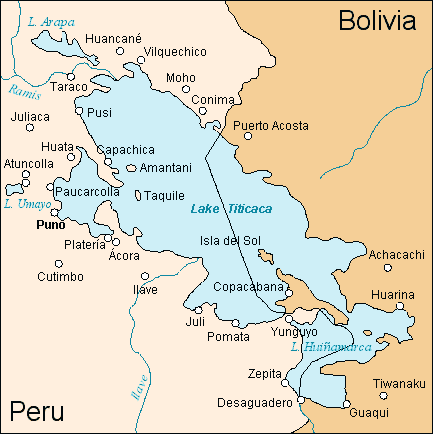
Bolivia: Lake Titicaca


The most prominent feature of the Altiplano is the large lake at its northern end, Lake Titicaca. At 3,810m above sea level, it is the highest commercially navigable body of water in the world. With a surface area of 9,064km, it is larger than Puerto Rico and is South America's largest lake. Lake Titicaca is also deep, about 370m at its maximum, but with an average depth of 215m; its volume of water is large enough to maintain a constant temperature of 10°C. The lake actually moderates the climate for a considerable distance around it, making crops of maize and wheat possible in sheltered areas.

Lake Titicaca drains southward through the slow-moving, reed-filled Desaguadero River to Lake Poopó. In contrast to the freshwater Lake Titicaca, Lake Poopó is salty and shallow, with depths seldom more than four meters. Because it is totally dependent on seasonal rainfall and the overflow from Lake Titicaca, Lake Poopó's size varies considerably. Several times in the twentieth century, it nearly dried up when rainfall was low or the Desaguadero River silted. In years of heavy rainfall, however, Lake Poopó has overflowed to the west, filling the Coipasa Saltpan with shallow water.
Phone cards Canada phone cards India phone cards France phone cards Russia phone cards UK phone cards USA phone cards Bizon phone card Jupiter calling card Mozart calling card Continental calling card

Thursday, May 18, 2006

Bolivian Climate

Although Bolivia lies entirely within tropical latitudes, climatic conditions vary widely from tropical in the lowlands to polar in the highest parts of the Andes. Temperatures depend primarily on elevation and show little seasonal variation. In most locations, rainfall is heaviest during the Southern Hemisphere summer, and yearly amounts tend to decrease from north to south.

Northern lowland areas have a tropical wet climate with year-round high temperatures, high humidity, and heavy rainfall. Daytime highs average more than 30° C all year in most locations. The rain-bearing northeast trade winds, blowing across the Amazon Basin, bring significant rainfall amounts. Rain often falls in brief thunderstorms, sometimes accompanied by strong winds and hail.

Central lowland areas have a tropical wet and dry climate. From October through April, northeast trade winds predominate, and the weather is hot, humid, and rainy. From May through September, however, dry southeast trade winds take control, and precipitation is minimal. During this season, clear days and cloudless nights allow for higher daily maximums and lower nightly minimums than occur during the rainy season. Occasional incursions of strong winds from the south, called surazos, can reach this region during winter and bring cool temperatures for several days.

The Chaco has a semitropical, semiarid climate. The northeast trade winds bring rain and hot humid conditions only from January through March; the other months are dry with hot days and cool nights. Bolivia's highest maximum temperature, 47° C, was recorded here. Surazos also affect the Chaco; their approach is usually signaled by a squall line.

Temperatures and rainfall amounts in mountain areas vary considerably. The Yungas, where the moist northeast trade winds are pushed up by the mountains, is the cloudiest, most humid, and rainiest area, receiving up to 152 centimeters annually. Sheltered valleys and basins throughout the Cordillera Oriental have mild temperatures and moderate rainfall amounts, averaging from 64 to 76 centimeters annually. Temperatures drop with increasing elevation, however. Snowfall is possible at elevations above 2,000 meters, and the permanent snow line is at 4,600 meters. Areas over 5,500 meters have a polar climate, with glaciated zones. The Cordillera Occidental is a high desert with cold, windswept peaks.

The Altiplano, which also is swept by strong, cold winds, has an arid, chilly climate, with sharp differences in daily temperature and decreasing amounts of rainfall from north to south. Average highs during the day range from 15°C to 20°C, but in the summer tropical sun, temperatures may exceed 27° C. After nightfall, however, the thin air retains little heat, and temperatures rapidly drop to just above freezing. Lake Titicaca exerts a moderating influence, but even on its shores, frosts occur in almost every month, and snow is not uncommon.

Popular Posts