Language
Spanish is the main and official language of Bolivia. However there are some 39 other living languages used in the country spoken by people in different regions. Examples include Aymara, Chiquitano, Chiriguano and Guyara. Some 50% of the population have an indigenous language as their mother tongue.
Bolivian Spanish as a result of mixing with its indigenous rivals differs from region to region. The vocabulary and pronunciation differs according to where in Bolivia you are, i.e. highlands (Altiplano and valleys) or the lowlands (Santa Cruz, Beni and Pando).
Religion
Most Bolivians are born into Roman Catholicism. Religion tends to be a female dominated activity in terms of attending church and the lie. Catholicism to some extent has been “localized” as it became intertwined with local folklore and customs in its early years of taking root in the country.
The Family
The family is the axis of the social life and structure. Families are very tight knit and in rural areas, many generations still often live together in one house. The extended family or “familia” serves as a strong support and network system. Roles within the family are very traditional – “Machismo” is very much alive. The wife is generally responsible for domestic duties whereas the husband with be the bread winner. The machismo mentality often translates into a feeling of male superiority and a strong sense of honor which means maintaining face/dignity at all cost.
Tuesday, May 16, 2006

Friday, May 12, 2006
Geography of Bolivia
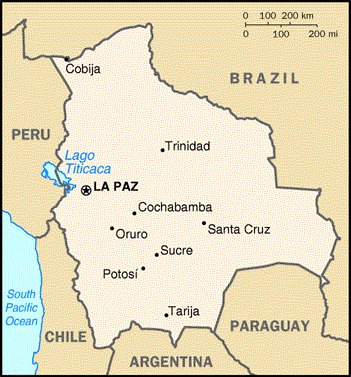
At 424,135 mi² (1,098,580 km²[1]), Bolivia is the world's 28th-largest country (after Ethiopia). It is comparable in size to Mauritania, and is half again as large as the US state of Texas.
Bolivia is a landlocked nation; it lost its connection to the Pacific coast in the War of the Pacific in 1879. However, it does have access to the Atlantic via the Paraguay river. The west of Bolivia is situated in the Andes mountain range, with the highest peak, Nevado Del Sajama at 6,542 metres (21,463 ft) located at the department of Oruro. The landscape encompasses many different backgrounds, which provide a beautiful view in one of the most incredible natural experiences one can experience. The west of the country is formed by a highland plateau, the Altiplano. The east of the country is lowland, and covered by the Amazonian rainforests. Lake Titicaca is located on the border between Bolivia and Peru. In the west, in the department of Potosí, lies the Salar de Uyuni, the world's largest salt flat.
Major cities are La Paz, Santa Cruz de la Sierra and Cochabamba.
Thursday, April 20, 2006
New Light on Bolivian Cultural Heritage
New Light on Bolivian Cultural Heritage: Finnish university experts give a face to the ancient Tiwanaku people (400-1050 A.D.)
“Now we know what the Tiwanaku people looked like,” Professor Martti Pärssinen, director of the South Central Andean Cultural Heritage Project of the University of Helsinki, told a group of experts assembled in the French Embassy in Bolivia on October 23 and 24, 2004.
Photo: Antti Korpisaari

A pair of condor-shaped vessels representing the many animal-shaped ceramics found in Pariti in 2004.

A pair of condor-shaped vessels representing the many animal-shaped ceramics found in Pariti in 2004.
In this meeting in La Paz, sponsored by the Finnish and French Ministries for Foreign Affairs, the most spectacular news was the discovery of an ancient Tiwanaku ceramics offering on the small island of Pariti in Lake Titicaca, Bolivia.
The discovery was made during a short fieldwork period in August 2004. The work was conduced by Antti Korpisaari MA and Jedú Sagárnaga Lic., members of a Finnish-Bolivian research team.
In a test pit excavated by Korpisaari some 300 kilos of broken ceramics were found. They had been deposited in the circular pit that was approximately 70 cm in diameter. The pit was discovered at a depth of about 130 cm below present surface level and it terminated close to groundwater level, at a depth of 310 cm.
According to Dr. Högne Jungner, director of the Dating Laboratory of the University of Helsinki, the six recovered radiocarbon samples demonstrate that the offering was made approximately between 850 and 1050 A.D.
| Photo: Antti Korpisaari  A portrait vessel representing a man adorned with a lip plug (tembeta) and earplugs. | Photo: Antti Korpisaari  A ceramic head from Pariti representing a man with a hole for a lip plug (tembeta). |
Canada phone cards India phone cards France phone cards Russia phone cards UK phone cards USA phone cards Bizon phone card Jupiter calling card Mozart calling card Continental calling card
Saturday, April 15, 2006
Uncovering a Niche Market: Bolivian Organic Foods
Sure, the big business news from Bolivia right now include problems with LAB, problems with Repsol, problems with El Mutún, problems with clothing imports and promises from Petrobras...Overlyy negative stuff.
However, I thought it would beworthwhilee to look at an interesting and positive news item in today's La Razón. Chapare Exporta, the agribusiness company founded by Miguel Zambrana[1] 15 years ago, has just begun banana exports to Europe. A historic landmark for a small Bolivian company given the strict agricultural protections common in the European Union. According to Zambrana the European market for bananas and its derivatesurpasseses $US 5.000 million a year, the objective of the company is to capture 10 percent of that market in the next few years. Bolivian banana exports currently cover 30-40 percent of thArgentineanan market, and with quotas and other trade barriers ineighborur countries expanding to European, Asian and North American markets seems a logical step.
On a similar step, other Bolivian agricultural companies are striving to promote their products abroad and enter new markets. Fourteen such companies will be exposing their products in the BioFach 2006 fair [2], in Nuremberg, Germany, in the next few days. Products promoted include organic quinoa, coffee, tea, medicinal herbs, dehydrated fruits, and others. Some of the companies include: Anapqui, Andean Valley S.A, AOPEB, BioCrush S.A, Coronilla S.A., El Ceibo Ltda. Irupana AOF and Hahenmann Labs.
Bolivian companies specializing in agricultural and organic products will also be present in other upcoming trade fairs, including Foodex in Japan, Agroexpo in Colombia, Interzum in Germany and Fancy Foods Show in the US.
A so it goes, slowly but surely Bolivian private enterprise has found a niche in selling high quality organic foods internationally. If only we had more free trade agreements.
Notes:
[1] Some may remember Mr. Miguel Zambrana for his daring attempt of suing then congressman and sindicate strong-man Evo Morales and other MAS nomenklatura for damages caused by the constant blockades in el Chapare in past years. Week long blockades derived in months worth of production rotting in trucks on their way to Argentina, contracts being defaulted and other losses. It's surprising to see how Chapare Exporta has recovered.
[2] For a complete listing and contact addresses of many of the companies cited here, click on this link.
However, I thought it would beworthwhilee to look at an interesting and positive news item in today's La Razón. Chapare Exporta, the agribusiness company founded by Miguel Zambrana[1] 15 years ago, has just begun banana exports to Europe. A historic landmark for a small Bolivian company given the strict agricultural protections common in the European Union. According to Zambrana the European market for bananas and its derivatesurpasseses $US 5.000 million a year, the objective of the company is to capture 10 percent of that market in the next few years. Bolivian banana exports currently cover 30-40 percent of thArgentineanan market, and with quotas and other trade barriers ineighborur countries expanding to European, Asian and North American markets seems a logical step.
On a similar step, other Bolivian agricultural companies are striving to promote their products abroad and enter new markets. Fourteen such companies will be exposing their products in the BioFach 2006 fair [2], in Nuremberg, Germany, in the next few days. Products promoted include organic quinoa, coffee, tea, medicinal herbs, dehydrated fruits, and others. Some of the companies include: Anapqui, Andean Valley S.A, AOPEB, BioCrush S.A, Coronilla S.A., El Ceibo Ltda. Irupana AOF and Hahenmann Labs.
Bolivian companies specializing in agricultural and organic products will also be present in other upcoming trade fairs, including Foodex in Japan, Agroexpo in Colombia, Interzum in Germany and Fancy Foods Show in the US.
A so it goes, slowly but surely Bolivian private enterprise has found a niche in selling high quality organic foods internationally. If only we had more free trade agreements.
Notes:
[1] Some may remember Mr. Miguel Zambrana for his daring attempt of suing then congressman and sindicate strong-man Evo Morales and other MAS nomenklatura for damages caused by the constant blockades in el Chapare in past years. Week long blockades derived in months worth of production rotting in trucks on their way to Argentina, contracts being defaulted and other losses. It's surprising to see how Chapare Exporta has recovered.
[2] For a complete listing and contact addresses of many of the companies cited here, click on this link.
Wednesday, September 21, 2005
Bolivia: Santa Cruz
Not the small town feels seeing that Santa Cruz is the capital of its department and hits close to the million mark population wise. But it was only a stopover to get our plane ticket to Puerto Suarez and cross into Brazil to do the Pantanal.
We decided to head to the zoo and see some of the local birds and animals of the region. A simple journey at first that upon return turned into a 2 hour missed-stop bus journey deep into the local neighborhoods, maybe 15km south of the city.
Leaving first thing in the morning and arriving in the same morning was a novel concept. What a weird feeling to actually be on a plane. Modern, swift travel after many bumpy, uncomfortable miles under our bums!!! A short hour later and we bounced twice on the tarmac before quickly disembarking in Pto. Suarez.
A bit of panic set in.....Rachel could not find her passport. We tore apart our money belts and inside our day packs...nothing. Another search and she found it. She had missed her zipper and it luckily had gotten stuck against the front of her jeans. Thankfully not falling out on either tarmac or inside the plane that was slowly on taxi to Sao Paolo.
Next problem....the lady at immigration in Santa Cruz had taken our entry papers to Bolivia that you need to surrender upon leaving. The two immigration guys did not buy our story (even though it was the truth. but then again they probably get it all the time from idiot travelers who lose their papers en route). That plane was continuing on to Sao Paolo, Brazil, hence the reason she must have forgotten to give us our papers back. A bit panicked and trying to tell them our story, we ended up paying a few Bolivians more for an exit stamp and we were on our way. Thankfully.
A guy from the Pantanal agency (Green Track) we ended up going with spoke English and helped us catch a taxi to the Brazilian/Bolivian border and gave us a lift to their pousada. We got to steamy Corumba on the Brazilian side to find that once again we were in a town having a founding celebration, hence everything was closed up. So we grabbed a few beers, caught a nap, grabbed the best pizza in town with the locals, walked around the street party and crashed. Our Pantanal tour was leaving first thing in the morning.
We decided to head to the zoo and see some of the local birds and animals of the region. A simple journey at first that upon return turned into a 2 hour missed-stop bus journey deep into the local neighborhoods, maybe 15km south of the city.
Leaving first thing in the morning and arriving in the same morning was a novel concept. What a weird feeling to actually be on a plane. Modern, swift travel after many bumpy, uncomfortable miles under our bums!!! A short hour later and we bounced twice on the tarmac before quickly disembarking in Pto. Suarez.
A bit of panic set in.....Rachel could not find her passport. We tore apart our money belts and inside our day packs...nothing. Another search and she found it. She had missed her zipper and it luckily had gotten stuck against the front of her jeans. Thankfully not falling out on either tarmac or inside the plane that was slowly on taxi to Sao Paolo.
Next problem....the lady at immigration in Santa Cruz had taken our entry papers to Bolivia that you need to surrender upon leaving. The two immigration guys did not buy our story (even though it was the truth. but then again they probably get it all the time from idiot travelers who lose their papers en route). That plane was continuing on to Sao Paolo, Brazil, hence the reason she must have forgotten to give us our papers back. A bit panicked and trying to tell them our story, we ended up paying a few Bolivians more for an exit stamp and we were on our way. Thankfully.
A guy from the Pantanal agency (Green Track) we ended up going with spoke English and helped us catch a taxi to the Brazilian/Bolivian border and gave us a lift to their pousada. We got to steamy Corumba on the Brazilian side to find that once again we were in a town having a founding celebration, hence everything was closed up. So we grabbed a few beers, caught a nap, grabbed the best pizza in town with the locals, walked around the street party and crashed. Our Pantanal tour was leaving first thing in the morning.
Sunday, September 18, 2005
Bolivia: Sucre
After the wild taxi ride from Potosi. We found a nice hotel with one English Channel on TV and ventured out to the travelers favorite called the Joy Ride Cafe. A Dutch-run hangout with huge portions, good service and varied menu kept us happy like Jack’s Cafe in Cusco too many weeks before to remember. So it seems as every day and another new adventure passes by.
Sunday in Sucre was very quiet. Not a thing open. Actually quite a nice way to walk around and see why it is called -The Athens of the Americas-. White washed buildings and red tiled roofs. We sampled the locally made chocolate from Para Ti which was pretty good.
We enquired about a quick 40 minute flight up to Santa Cruz or the 17 hour bus ride, but cost became the issue and we booked our seats and headed off late in the afternoon. The first 9 hours were another hellish washboard journey on switchback roads following every other bus on the same route. Finally, the sun came up and we hit the massive bus terminal in Santa Cruz.
http://www.traveljournals.net/stories/9513.html
Sunday in Sucre was very quiet. Not a thing open. Actually quite a nice way to walk around and see why it is called -The Athens of the Americas-. White washed buildings and red tiled roofs. We sampled the locally made chocolate from Para Ti which was pretty good.
We enquired about a quick 40 minute flight up to Santa Cruz or the 17 hour bus ride, but cost became the issue and we booked our seats and headed off late in the afternoon. The first 9 hours were another hellish washboard journey on switchback roads following every other bus on the same route. Finally, the sun came up and we hit the massive bus terminal in Santa Cruz.
http://www.traveljournals.net/stories/9513.html
Subscribe to:
Posts (Atom)
Popular Posts
-
The country of Bolivia is probably not a well known place for many tourists probably because it is one of the highest and most remote count...
-
International corporate conspiracy, fighting in the streets of Bolivia with tear gas and bullets and a power struggle at the highest levels...
-
The natural untouched beauty of the mighty Andean mountain range, the majestic Inca ruins of Machu Picchu and Lake Titicaca Islands that ar...
-
Bolivia is one of those countries that frustrates you into loving it. Given enough time, its quirkiness is what makes you keep coming back ...
-
At more than 13,000 feet above sea-level in the Andes, we were as close to heaven as most mortals can hope to get - and closer to hell than...
-
New Light on Bolivian Cultural Heritage: Finnish university experts give a face to the ancient Tiwanaku people (400-1050 A.D.) Joe ...
-
At 424,135 mi² (1,098,580 km²[1]), Bolivia is the world's 28th-largest country (after Ethiopia). It is comparable in size to Mauritania,...
-
Sure, the big business news from Bolivia right now include problems with LAB, problems with Repsol, problems with El Mutún, problems with cl...
-
Brazil, with its diverse culture, growing economy and natural wonders, is fast becoming one of the top immigrations destinations. Since Br...
-
The most prominent feature of the Altiplano is the large lake at its northern end, Lake Titicaca. At 3,810m above sea level, it is the highe...


